
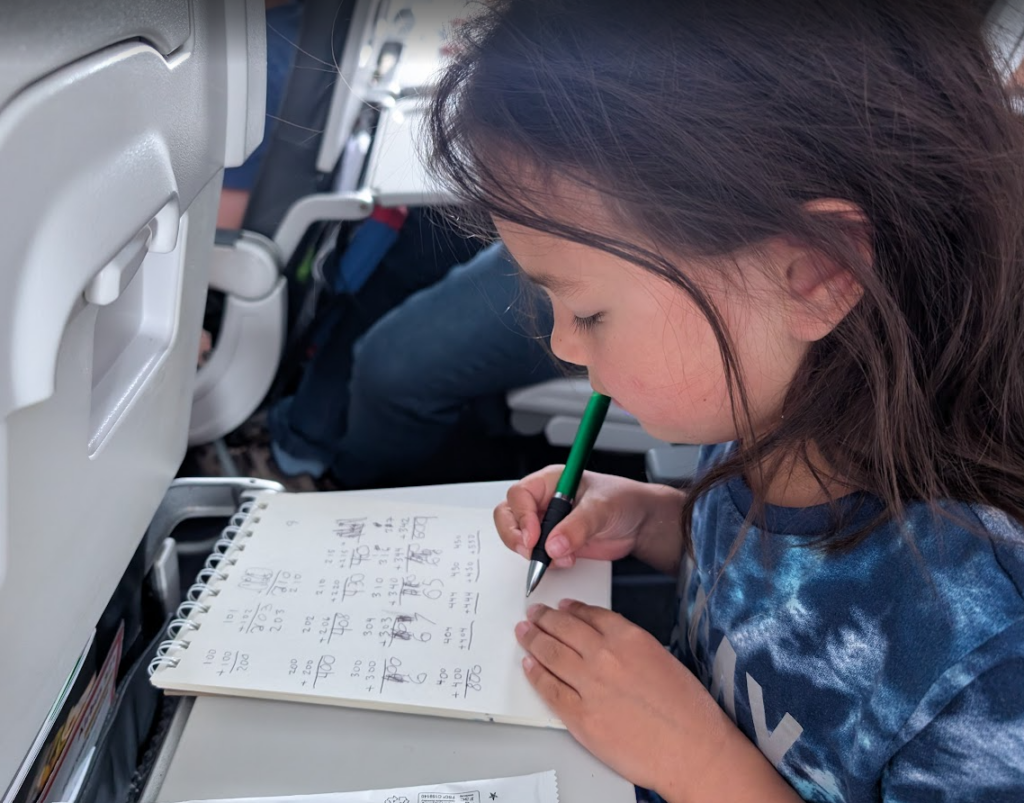
When we first signed up for our sabbatical, we knew we wanted to travel extensively during our year away — and that meant taking the girls’ education into our own hands. Fortunately, the girls are still quite young, so their academic needs felt manageable for us. Isabel will be 5 years old and entering senior kindergarten, and Emmalyn will be 7 years old and entering Grade 2 at the start of our trip.
We started planning early, talking with the girls’ school and teachers about our upcoming year abroad. We had open conversations about available resources and the areas we should focus on. The girls attend a small K–8 school with about 300 students across ten grade levels (we have two years of kindergarten here in Ontario). Their teachers have been incredibly supportive — quick to reassure us that the girls will learn so much simply by traveling, and that they’ll easily catch up on anything academic they may miss.
And while no one pressured us to dive deeply into curriculum or teaching strategies, I have to admit: I love the concept of homeschooling. Not that we don’t also value the public school system — we absolutely do and our girls love their classes and teachers — but the idea of choosing topics the girls are excited about, following their interests, sharing knowledge, and learning new things right alongside them feels like a dream. Our girls genuinely love learning, and maybe that’s because we’re always eager to learn new things ourselves… or maybe we just lucked out. Either way, it certainly helps that they ask daily to work on their math or reading workbooks even at home.
As we dug more into what homeschooling while traveling might look like, we discovered that it’s not just a thing — it’s a whole movement, practiced by a surprising number of families, and it has its own name: worldschooling. The more we explored it, the more it felt like the perfect fit for our year abroad. There are countless online resources and books that go deep into the philosophy and methods, but we want to share what worldschooling means to us, and how we plan to use it for our family.
So… What Exactly Is Worldschooling?
At its core, worldschooling is learning from the world around you.
It’s not a curriculum, school type, or even one specific method.
Worldschooling is the idea of using your surroundings — wherever you are — to teach, inspire curiosity, and spark meaningful questions.
Worldschooling families often blend:
- Traditional homeschooling (curriculum based reading, writing, math)
- Experience‑based learning (visiting museums, nature, history, food)
- Real‑world life skills (navigation, budgeting, currency conversion, languages)
- Child‑led curiosity (following what sparks their interest)
- Cultural immersion (meeting people, learning customs, understanding differences)
There’s no one right way to worldschool. Some families do it full‑time. Some do it during vacations. Some weave it into day‑to‑day life without ever leaving their hometowns. In fact, before we even knew the word worldschooling, we were already doing it on our vacations.
The biggest strength of worldschooling? Its flexibility.
Different countries, different accommodations, different schedules — nothing about this year will be predictable, and worldschooling fits beautifully into that reality.
In addition to building lessons around the opportunities each destination offers, we’re still planning to incorporate the essentials — reading, writing, and math — in ways that are portable, flexible, and realistic. Kindergarten is a pivotal year to establish early literacy skills that will be built on for years to come. Once we’re on the road, we’ll share more about our actual worldschooling setup, including the tools, books, and rhythms we find. But at a high level: yes, the kids will continue learning their core subjects. No, it won’t look anything like a typical classroom. And that’s kind of the point.
We’re not aiming for perfection.
We’re not trying to recreate school on the road.
We’re not expecting calm, Instagram‑worthy learning moments every day, although that would be nice.
Our goal is simply this:
Help our kids continue to discover their joy of learning, wherever we are.
Some days that might mean a math lesson on a café napkin.
Some days it might mean climbing ruins, exploring markets, or listening to a guide.
Some days it might be nothing more than resting and journaling.
And that’s okay. The world is a pretty incredible teacher and we can’t wait to learn from it.